Research
Does staging help sell a house?
Short answer
Staging probably helps sell a house, mainly by helping buyers picture living there. In the National Association of Realtors' 2025 survey, 83% of buyers' agents said so and 49% of sellers' agents reported faster sales. A higher price is not proven: experiments in 2015 and 2023 found no price effect, and one 2026 working paper found about 10% more.
- By Moe A.
- Published
- 7 min read
Key facts
- 83% of buyers' agents said staging makes it easier for a buyer to picture the home as their own (NAR survey of 1,266 agents, February 2025).[1]
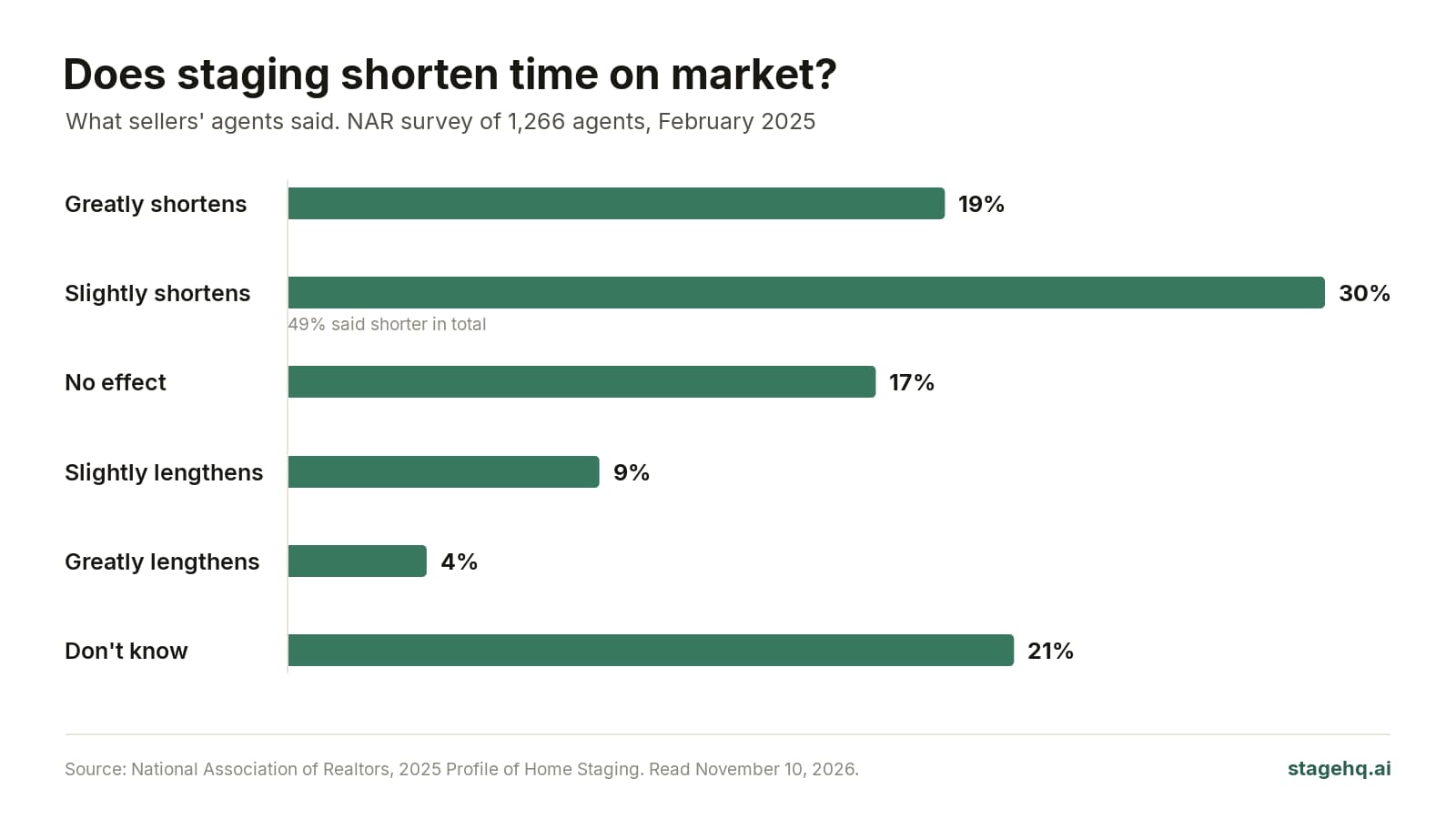
- 49% of sellers' agents said staging shortened time on market (NAR, 2025).[1]
- In a 2015 experiment with 820 people, staging did not change the value they put on a home (Journal of Housing Research).[4]
- A 2026 working paper on 17,429 home sales found furnished-looking listings sold for roughly 10% more. It is not peer reviewed yet.[6]
- 81% of buyers who searched online rated photos very useful, more than any other website feature (NAR, 2026 report).[8]
Staging probably helps, but not in the way most statistics claim. The evidence is strongest that it helps buyers picture a home, weaker that it shortens time on market, and thin on price.
This post sorts every number by who produced it: agents, stagers or researchers. For figures on virtual staging alone, see our virtual staging statistics guide.
What do real estate agents say about staging?
Most agents say staging helps buyers picture the home, and about half say it shortens the sale. The best source is the 2025 Profile of Home Staging from the National Association of Realtors (NAR). In February 2025, NAR invited 49,806 members to an online survey and 1,266 answered, a response rate of 2.5%.[1]
- 83% of buyers' agents said staging made it easier for a buyer to picture the property as a future home.[1]
- 49% of sellers' agents said staging shortened time on market: 19% greatly, 30% slightly. Another 17% saw no effect, 13% said it lengthened the sale, and 21% did not know.[1]
- 29% of sellers' agents said staging raised the offer by 1% to 10%. But 30% saw no effect on price and 34% were not sure.[1]
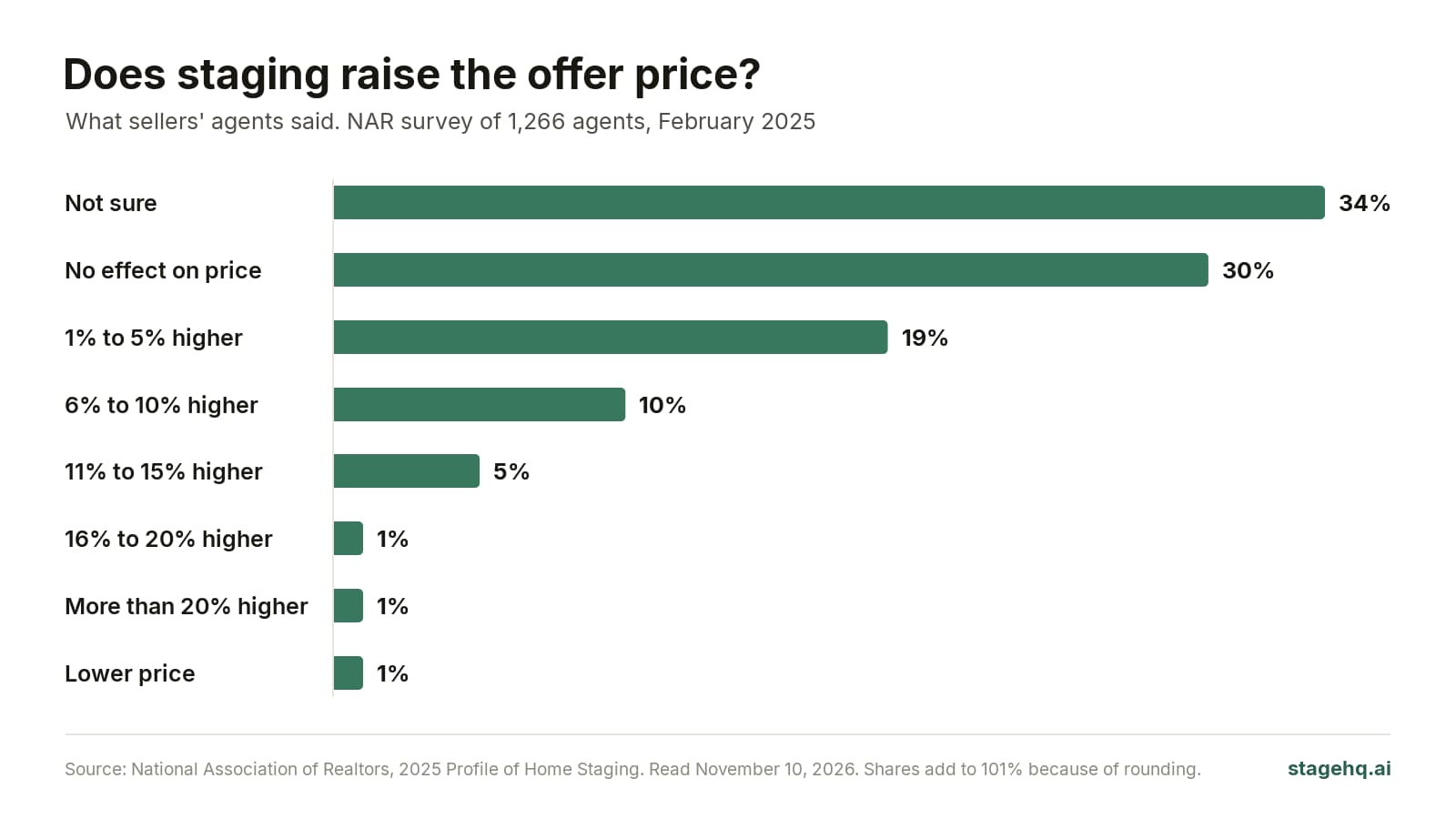
Read these as opinions. NAR asked agents what they believe they saw and did not compare sale records for staged and unstaged homes. With a 2.5% response rate, agents who care about staging may also have been more likely to answer.
Do staged homes sell faster?
Probably somewhat, but we found no study that measures it with a fair comparison. The fast numbers come from stagers. On its statistics page, the Real Estate Staging Association (RESA) reports an average of 9 days to an accepted offer across 114 staged homes in the third quarter of 2026.[2] Stagers submit those homes themselves, with no unstaged group beside them. RESA's note on its first-half 2026 report says the results reflect participating properties, not all staged homes, and "do not isolate staging's effect."[2]
The most repeated figure, "staged homes sell 73% faster," traces to a 2011 RESA consumer guide. It describes 174 homes that sat unsold for an average of 156 days, were then staged and relisted, and sold in an average of 42 days.[3] That is a before-and-after on homes that had already failed to sell. A relisting can come with a lower price, new photos or a new agent, and the guide records none of that. Our own statistics guide quotes this figure and similar industry numbers, so read them with that context.
The 2015 experiment covered next could not test time on market either.[4] So the honest reading: about half of agents report shorter sales, the direction is plausible, and the size of the effect is unknown.
Do staged homes sell for more?
This is not proven, and the best studies disagree. In a 2015 experiment in the Journal of Housing Research, Lane, Seiler and Seiler showed 820 people from a national research panel one of six versions of the same virtual home tour: good furniture, poor furniture or no furniture, each with neutral or unattractive wall color.[4] The average value estimates for the six versions fell between $203,263 and $205,914, and none of the differences was statistically significant.[4]
Staging still changed how people felt. On a 9-point scale, the empty version scored about 0.3 points lower on overall impression and 0.5 points lower on livability than the furnished baseline.[4] The 77 real estate agents the authors also asked expected staging to move the price.[4] The limits: a virtual tour, hypothetical values, and participants somewhat younger than homeowners nationally.
Two later papers pull in different directions. A 2023 study in the same journal showed students apartment photos with or without furniture. It again found no significant difference in value estimates overall, though people looked longer at the furnished photos.[5] A 2026 working paper used software to detect furniture in the listing photos of 17,429 sales. It found that furnished-looking homes sold for roughly 10% more than comparable homes without furniture, and its online experiment also found higher valuations for staged homes.[6] It is a working paper and has not passed peer review.
Real sales data has a built-in problem: empty homes sell for less for reasons that go beyond furniture. Redfin's analysis of homes sold in 2018 found that vacant homes sold for $11,306 less and took about six days longer than comparable occupied homes.[7] Its chief economist pointed to the seller's position: buyers read an empty home as a sign they can take their time. A furnished-against-empty comparison picks up some of that.
Selection bias in plain words
A statistic is only as fair as the way its homes were picked. RESA's sale-price figures come from a program called the Sold Over List Price Club, so the average lands above asking by design: 113% of list price for the third quarter of 2026.[2] Sellers who pay for staging may also prepare, price and photograph the home with more care, which would lift results with or without the furniture.
Which home staging statistics can you trust?
Trust each number for what it measures, and no further. The table lists each source with its sample and main caveat.
| Source | Year | Who was asked or measured | Sample | Finding | Caveat |
|---|---|---|---|---|---|
| NAR, Profile of Home Staging[1] | 2025 | Agents, online survey | 1,266 of 49,806 invited | 83% of buyers' agents: easier to picture the home. 49% of sellers' agents: shorter sale | Opinions, not sale records. 2.5% response rate |
| RESA, quarterly statistics[2] | 2026 | Staged homes reported by stagers | 114 homes, third quarter | 9 days to an accepted offer. 113% of list price | Self-reported. No unstaged group. Prices from homes sold over list |
| RESA, consumer guide[3] | 2011 | Homes staged after sitting unsold | 174 homes | 156 days unsold, then 42 days after staging | Relisted homes. Price or agent changes not recorded |
| Lane, Seiler and Seiler[4] | 2015 | Panel members, one of six virtual tours each | 820 people, 77 agents | No significant change in value. Empty home scored lower on livability | Hypothetical values. Time on market not tested |
| Thaler and Koch[5] | 2023 | Students shown photos with or without furniture | Not in the abstract | No significant value difference overall. Longer viewing of furnished photos | Students. Estimates, not sales |
| Bhattacharya and co-authors[6] | 2026 | Home sales, furniture detected in listing photos | 17,429 sales | Furnished-looking homes sold for roughly 10% more | Not peer reviewed. Furnished can mean lived in |
| Redfin[7] | 2019 | Homes sold in 2018, vacant against occupied | 17 metro areas | Vacant homes sold for $11,306 less, about six days slower | Measures vacancy, not staging |
| NAR, Generational Trends[8] | 2026 | Recent buyers, mail and online survey | 6,103 responses | 81% of online searchers rated photos very useful | Photos in general, not staged photos |
Sources read on November 10, 2026.
Does virtual staging work?
It acts on the part of the sale that happens in photos, but we found no independent study that measures its effect on sale price or speed. In NAR's 2026 Generational Trends report, a survey of 6,103 recent buyers, 81% of those who searched online rated photos very useful, more than any other website feature.[8] In the 2025 staging survey, 31% of buyers' agents said buyers were more willing to walk through a staged home they had seen online.[1] And the experiments above ran on screens, not in person.
Agents still rank virtual staging below the physical kind. In NAR's 2025 survey, 18% of buyers' agents rated it as more important to their clients, against 57% for physical staging and 73% for photos.[1] That fits what it is: the listing photos change, and the room is still empty at the showing.
The case for virtual staging is cost. Agents in the NAR survey reported a median of $1,500 for a staging service.[1] StageHQ turns a photo of an empty or furnished room into a staged listing photo in about a minute, with prepaid packs from $19 for 20 photos and no subscription. With the price effect unproven, a cheap test makes more sense than a big bet. See our virtual staging cost guide, the post on what home staging costs, and our guide on whether virtual staging is worth it.
Label what you stage. StageHQ exports can carry a "Virtually staged" badge with the original and staged pair and a public verify link. Disclosure rules differ by MLS, so check yours, starting with our guide to MLS rules for virtual staging.
Should you stage before you list?
Stage when buyers would struggle to read the rooms, and judge it by cost, not by a promised price bump.
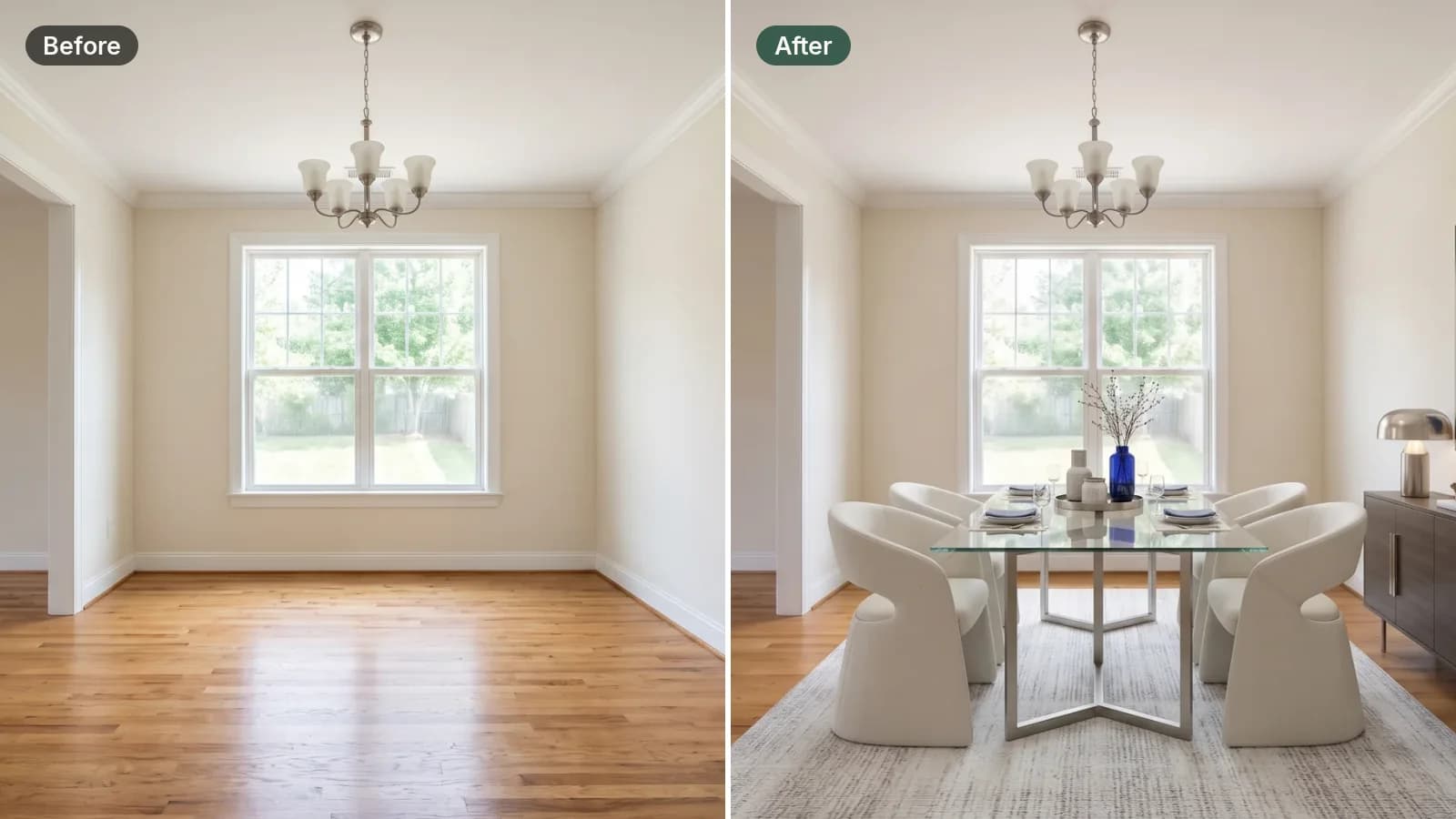
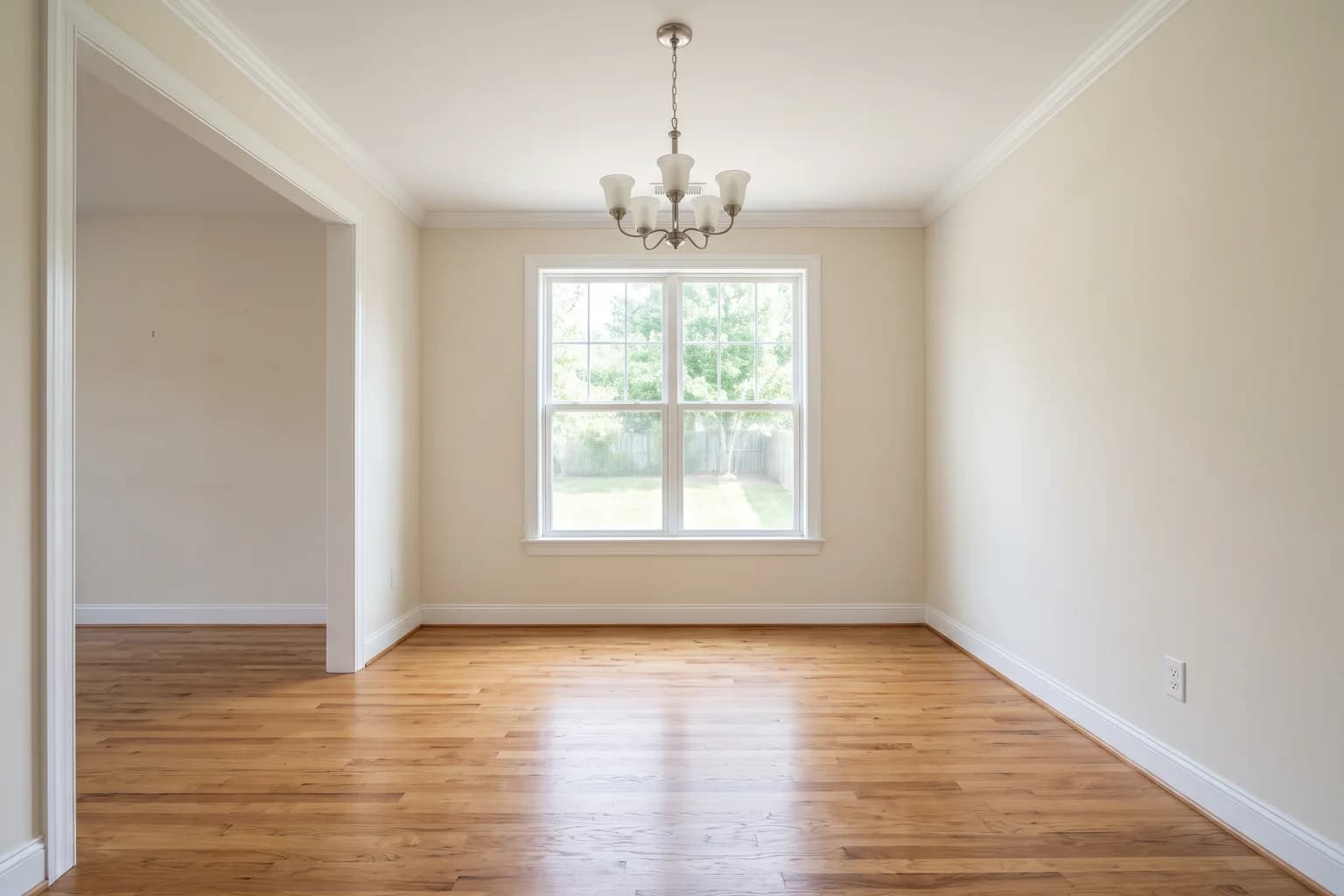 Before
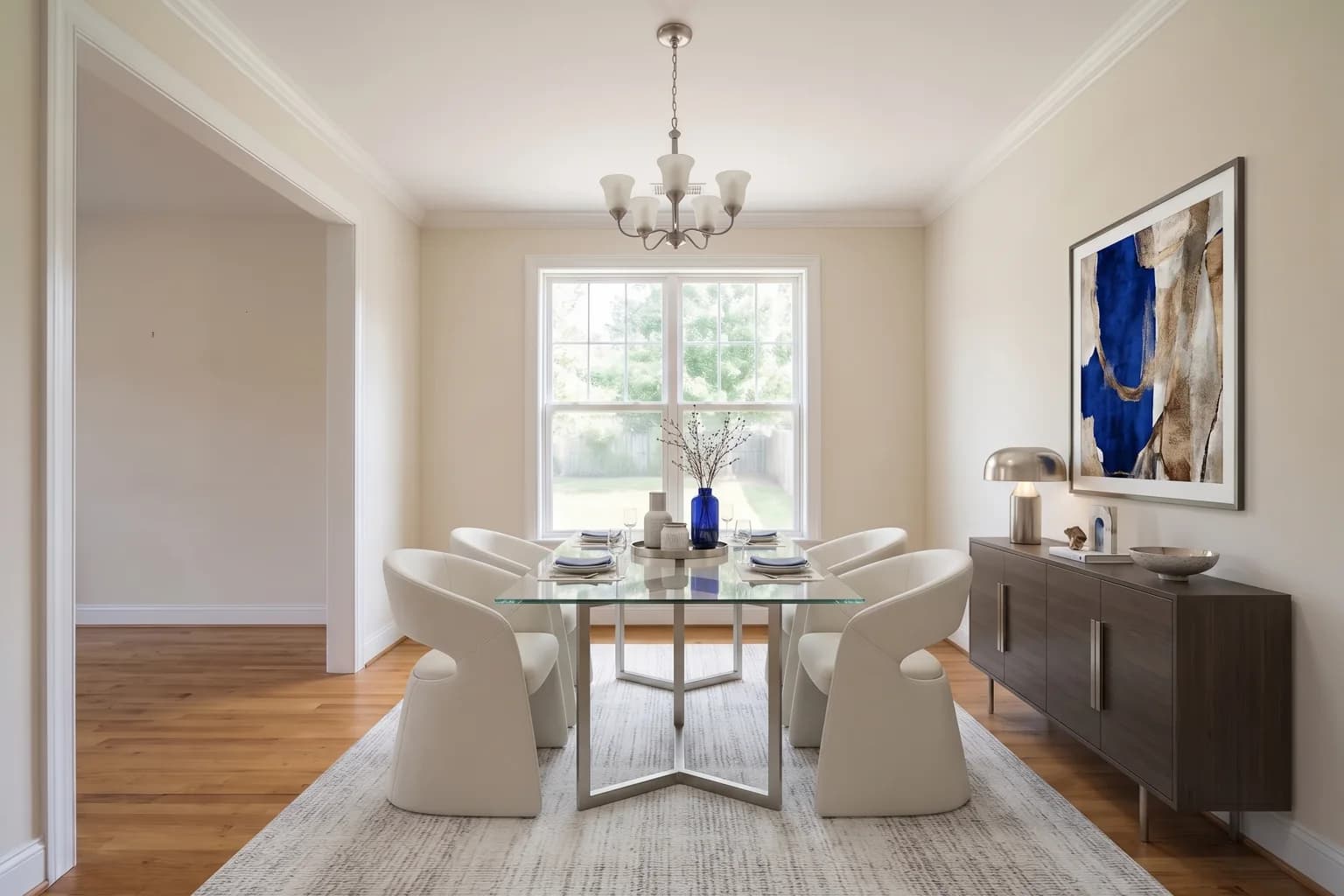 After
- Empty rooms gain the most. That is where the 2015 experiment found lower livability scores.[4]
- Start with the living room, then the primary bedroom. Sellers' agents staged those two most often: the living room (91%) and the primary bedroom (83%).[1] Our post on partial home staging covers which rooms to pick next.
- Treat any promised price increase as unproven. Count on photos that are easier to read and, possibly, a shorter wait.
Test it on one listing
Stage the living room and the primary bedroom of your next listing in about a minute each. Packs start at $19 for 20 photos, with no subscription.
How we know
We read every source on November 10, 2026 and used only figures from pages we opened: two NAR survey reports, RESA's statistics page and 2011 guide, Redfin's analysis, and three academic papers. We read the 2015 paper in full, in a copy hosted by FieldExperiments.com, and the abstracts of the 2023 and 2026 papers. StageHQ prices are from our own pricing page on the same day.
Co-founder of StageHQ. Last updated .
Sources
- 2025 Profile of Home Staging, National Association of Realtors, read
- Home Staging Statistics and Quarterly Market Insights (Q3 2026 and Q1 to Q2 2026 summaries), Real Estate Staging Association, read
- The Consumer's Guide to Real Estate Staging, Including 2011 Statistics (PDF, copy hosted by Fiore Interiors on topproducerwebsite.com), Real Estate Staging Association, read
- Lane, Seiler and Seiler, The Impact of Staging Conditions on Residential Real Estate Demand, Journal of Housing Research 24(1), 2015 (full text, copy hosted by FieldExperiments.com), Journal of Housing Research (Taylor & Francis), read
- Thaler and Koch, Real Estate Pictures: The Role of Furniture Preferences in Subjective Valuation, Journal of Housing Research 32(2), 2023 (abstract), Taylor & Francis, read
- Bhattacharya, Li, Wang, Wu and Zheng, Visual Cues and Valuation: Evidence from the Housing Market, working paper, 2026 (abstract), SSRN, read
- Do Vacant Homes Sell for Less Money? (analysis of homes sold in 2018, published 2019), Redfin, read
- 2026 Home Buyers and Sellers Generational Trends Report, Exhibit 3-6 (PDF, copy hosted by Inman), National Association of Realtors, read
FAQ
Common Questions
Which rooms should you stage first?
The living room, then the primary bedroom. In NAR's 2025 survey, 37% of buyers' agents called living room staging very important to buyers, 34% said the same of the primary bedroom and 23% of the kitchen. Sellers' agents most often staged the living room (91%) and the primary bedroom (83%).
Where does the "staged homes sell 73% faster" statistic come from?
From a 2011 guide by the Real Estate Staging Association. It describes 174 homes that sat unsold for an average of 156 days, then sold in an average of 42 days after staging and relisting. It is a before-and-after on relisted homes, not a comparison with unstaged homes.
Does staging help more in a vacant house?
Probably. In the 2015 experiment, the empty version of the home scored lower on overall impression and livability than the furnished one. Redfin found vacant homes sold for $11,306 less than comparable occupied homes in 2018, though that gap also reflects the seller's situation, not only the empty rooms.
How much does staging cost compared with virtual staging?
Agents in NAR's 2025 survey reported a median of $1,500 when they used a staging service and $500 when they staged a home themselves. StageHQ's virtual staging packs start at $19 for 20 photos and drop to $0.28 a photo on the largest pack, with no subscription.